An 89-meter observation wheel can be a strong investment when a park has the visitor base, site conditions, capital budget and long-term destination strategy to support it. It should be evaluated as a major attraction project rather than a stand-alone ride purchase. A proper 89m observation wheel investment case must combine equipment cost, construction scope, operating capacity, revenue sources and local approval requirements before an investor decides whether the project is suitable.
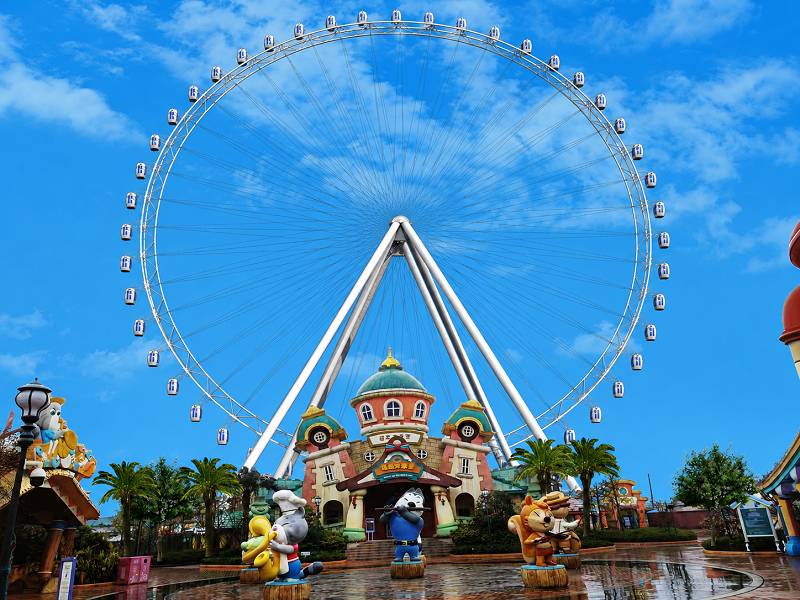
What Strategic Role Will the Observation Wheel Play?
The first question is not simply how many tickets the wheel can sell. Investors should define whether it will act as a park icon, a viewing attraction, a nighttime feature, a sponsorship platform or a catalyst for a wider tourism development. An observation wheel that is visible across a destination can support branding and wayfinding, but visibility alone does not guarantee commercial performance.
The target page presents 42-, 48- and 54-cabin configurations with total capacities of 288, 324 or 336 passengers. Those figures describe possible equipment configurations; actual hourly throughput will also depend on loading procedures, dispatch intervals, ride duration, accessibility needs and operating discipline. Management should compare realistic attendance forecasts with practical throughput rather than relying only on nominal capacity.
Does the Park Have the Right Market and Visitor Mix?
An 89m wheel is more appropriate for a destination park, resort, city park or tourism site with sustained visitor demand than for a small venue seeking one additional family ride. The attraction should serve more than a narrow thrill-seeking audience. Families, couples, tourists, school groups and corporate events may all contribute to demand when the cabins and guest experience are planned accordingly.
Investors should segment attendance by weekday, weekend, holiday and high season. They should also test different ticketing options, including a separate ticket, a park bundle, premium cabin products or event packages. The purpose is to determine whether the attraction can earn revenue across several visitor groups without depending on an unrealistic peak-day forecast.
Is the Site Ready for a Project of This Scale?
The supplier lists three structural arrangements with indicative footprints of approximately 39 × 45 meters, 42 × 37 meters and 41 × 31 meters. The construction boundary will normally be larger because the project also needs queues, exits, maintenance access, utilities, landscaping and crane working areas.
Site suitability depends on topography, soil conditions, groundwater, wind, seismic parameters and local planning rules. Investors should obtain a survey and geotechnical report before final engineering. If the site is still being selected, a 49m, 66m and 89m observation wheel comparison can help determine whether a smaller wheel would better match the available land, budget and attendance.
Can the Total Installed Budget Be Supported?
The supplier gives an equipment-only reference of approximately USD 1.5 million to USD 3 million for an 89m wheel. The installed project budget may also include foundations, utility upgrades, shipping, customs charges, cranes, erection labor, technical supervision, testing, landscaping, ticketing infrastructure and third-party review.
A large 89-meter Ferris wheel investment proposal should therefore separate equipment price from destination costs and include a contingency for site variations and freight changes. Financial planning can use a discounted cash flow model, but the assumptions for attendance, ticket yield, operating days, maintenance and financing should remain conservative.
What Revenue Sources Exist Beyond Standard Tickets?
An observation wheel may support premium cabins, private events, sponsorship, advertising, photography, food and beverage spending, and higher foot traffic for nearby retail. Custom lighting or LED display systems can also strengthen evening programming, subject to local permissions and the selected technical configuration.
These secondary revenues should be documented separately. Investors should not assume that every customization automatically creates income. Each option needs an operator, a sales plan and measurable demand. The best configuration is the one that fits the destination concept and can be operated consistently, not necessarily the one with the greatest number of features.
When Is an 89m Wheel a Sound Decision?
The project is more defensible when the park has verified demand, suitable land, adequate financing, clear approval responsibilities and an experienced operating team. It is less suitable when the business case depends on aggressive attendance growth, an incomplete site study or an underestimated installation budget.
Working with a DINIS turnkey theme park planning team can help buyers coordinate equipment selection with site planning and project scope. The final decision should still be based on the investor’s independent feasibility study and local professional advice. Detailed configurations can be reviewed at https://themeparkprojects.com/89m-giant-ferris-wheel-for-sale/
Leave a Reply