Investors often treat ride capacity as a technical specification, something the manufacturer quotes and the operator works around. In a park investment it is actually a financial variable: it sets the ceiling on how much revenue each attraction can produce, and therefore how quickly the capital can be recovered.
This article explains how capacity feeds into payback, and how to use it when comparing rides rather than when operating them. It sits alongside a how much does it cost to build an amusement park budget, where each ride is costed with its foundations and site work.
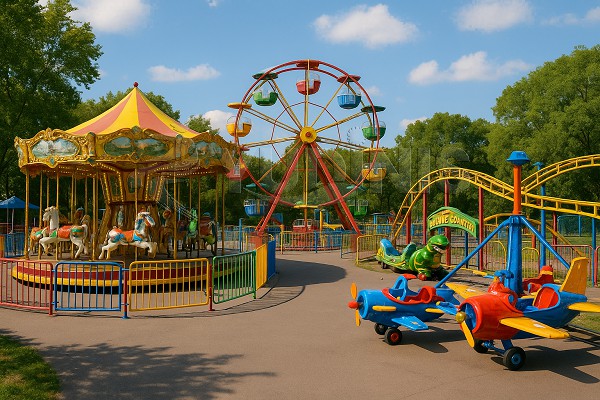
Capacity Sets the Revenue Ceiling
A ride’s hourly capacity, multiplied by operating hours, defines the maximum number of rides it can deliver in a day. Multiply that by the price per ride and the result is the maximum revenue the attraction can produce.
No park reaches that maximum. The useful figure is the proportion of capacity that demand actually fills, which is why two rides with identical capacity can have very different payback periods.
Utilisation Is Driven by the Park, Not the Ride
A ride is only as busy as the park around it. Attendance, dwell time and the number of competing attractions all determine how much of the capacity is used.
Adding a high-capacity ride to a park with limited attendance does not create passengers; it spreads the same visitors across more seats. That is why capacity should be sized to the park’s own demand curve rather than to a competitor’s.
Payback Uses Net Contribution
The payback period is the capital cost divided by the annual net contribution of the ride, not by its gross revenue. Staffing, power, maintenance and inspection all reduce the contribution.
This is where capacity becomes a two-sided question. A larger ride may earn more when full, but it also costs more to operate, and the extra operating cost is incurred even when the ride is running below capacity.

Compare Capacity per Unit of Capital
A useful measure is passengers per hour per unit of installed cost. It puts rides of different sizes on the same basis and exposes the ones that consume capital without adding throughput.
Run the same measure for a small family ride and a large thrill ride, and the ranking often surprises operators. The smaller ride frequently produces more capacity per euro because its foundations, footprint and operating cost are all lower.
Do Not Ignore the Queue
Capacity that cannot be loaded is not capacity. If the platform, the restraint system or the staff arrangement limits how quickly passengers board, the theoretical figure is never reached.
Ask the supplier for the realistic loading rate, not only the maximum. A ride that loads steadily all day often beats one with a higher headline figure and a slow platform.
Test the Payback at Different Utilisation Levels
Build the model at expected, low and high utilisation and see where the payback becomes uncomfortable. A ride that only pays back at full capacity is a bet on demand rather than an investment in it.
This is the practical use of an amusement park payback period model: it shows which rides remain viable when the park has a quiet season. A ride capacity and ROI comparison across the full list is more useful than judging each ride in isolation.
Where Capacity Planning Changes the List
Once payback is visible per ride, the list usually changes. Rides with strong capacity and low operating cost move up; rides that add prestige but little throughput move down or into a later phase.
Durability affects the same calculation, because a structure that needs less repair protects the net contribution. Specifying a defined steel grade and coating is one of the simplest ways to keep maintenance predictable over the payback period.
Dinis supplies rides for family parks and works as an amusement park rides manufacturer, providing capacity, power and maintenance data for each model so the payback can be modelled before purchase. A ride capacity planning from Dinis review can be prepared for a specific ride list: https://www.kidsparksolutions.com/how-much-does-it-cost-to-build-an-amusement-park/